
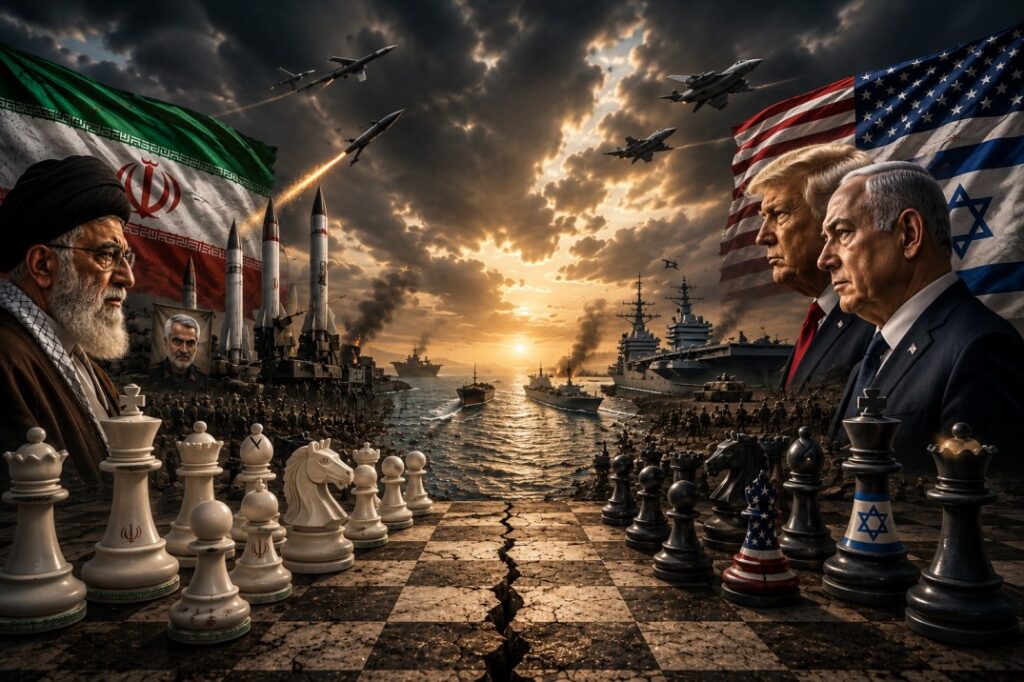
The US–Iran truce rests not on diplomacy or goodwill, but on a shared and demonstrated capacity for catastrophic, mutually unsustainable destruction. Today, in the wreckage of Kuwait International Airport’s passenger terminal, that truth is written in smoke and shattered glass.
This is day ninety-six of the 2026 Iran war. The ceasefire, brokered by Pakistan on April 8, declared repeatedly in effect by Washington, repeatedly violated by both sides, and now suspended by Tehran, is being tested at the hardest point yet.
Kuwait, June 3: The Strike That Says Everything
Iranian drones struck the main passenger terminal at Kuwait International Airport early this morning, killing one civilian, wounding more than sixty others and forcing an immediate suspension of all commercial flights. Kuwait’s airspace is closed until further notice.
Airlines including Kuwait Airways, IndiGo and Emirates have halted operations. Incoming aircraft are being diverted to Doha, Dubai and Riyadh. Simultaneously, Bahrain activated air raid sirens and ordered residents to take shelter as US and Bahraini forces claimed to have intercepted a wave of Iranian missiles and drones targeting the US Navy’s Fifth Fleet headquarters at Manama. The night also brought Iranian strikes on shipping lanes in the Arabian Gulf.
The airport had only reopened forty-eight hours earlier on June 1 — a brief, fragile signal that the war’s intensity might be easing. Kuwait has now suffered four major Iranian strikes since February 28 : its airport radar systems destroyed on the opening day of the war, six American soldiers killed at a US tactical operations centre at Port Shuaiba in early March, two MQ-9 Reaper drones destroyed and five Americans wounded at Ali Al Salem Air Base in late May, and now this morning’s strike on a civilian terminal. Iran’s IRGC stated clearly that today’s attacks were retaliation for a US missile that struck an oil tanker bound for Iran.
That sequence captures the precise logic of this conflict. The US strikes an Iranian tanker enforcing its naval blockade. Iran responds by hitting a civilian aviation hub in a country that shelters American forces. Washington insists the ceasefire is still in effect. Tehran says it has stopped communicating with mediators.
Another significant dimension of this conflict is the exposure of the limitations of modern air-defence systems. Despite assertions—and repeated wild exaggerations—of high interception rates, a slew of vital military bases, radar installations, command centres and strategic assets were successfully struck by precision missiles and target-seeking drones, underscoring the reality that even the world’s most advanced air-defence networks remain vulnerable to sustained and sophisticated attacks.
The Strait and the Tanker War
The immediate trigger for the current escalation cycle was a series of US strikes on Iranian oil tankers in and around the Strait of Hormuz — the narrow corridor through which close to one-fifth of the world’s traded oil and gas moves. American naval forces disabled two Iranian tankers in early May, seized a container ship attempting to breach the naval blockade and struck Iranian military facilities in response to attacks on three US Navy ships. Iran’s Revolutionary Guard announced that any assault on Iranian vessels would be met with heavy strikes on US bases across the Gulf. That threat has been methodically executed.
The escalation came despite — or because of — a significant earlier US action : the destruction of sixteen Iranian mine-laying vessels near the strait in March, following Trump’s public ultimatum to remove them.
The US released footage of those strikes as deterrence. Iran absorbed the message and intensified pressure on Gulf infrastructure instead. Oil prices have reflected every exchange. Brent crude surged toward one hundred dollars a barrel during the most intense weeks.
An oil spill from one of the struck tankers has been spreading southwest, with projections suggesting it could reach the coastlines of the UAE, Qatar and Saudi Arabia within days.
Iran has also created a new state agency asserting sovereign control over all commercial shipping movements through the strait — a bureaucratic declaration with profound strategic implications.
What the Campaigns Actually Proved
When Operation Epic Fury was launched on February 28, the scale was staggering — hundreds of strikes in the opening twelve hours, thousands of targets across Iran over the following weeks. It was claimed as a decisive blow to Iran’s military capacity. The honest assessment is more complicated.
Iran’s military depth — its ballistic missile reserves, its Revolutionary Guard formations, its drone production networks, its proxy architecture across Lebanon, Iraq, Syria and Yemen — was not substantially degraded.
Tehran had dispersed assets, hardened positions and retained the operational reach to strike across the entire Gulf simultaneously.
The joint US–Israeli campaign killed Iran’s supreme leader, destroyed some of its vast military infrastructure and set back its nuclear programme by an amount still disputed between intelligence agencies. What it could not do was break Iran’s capacity to impose painful costs on everyone in range.
Those costs have been immense and accumulating. Iranian strikes hit more than a hundred sites across at least eleven American military installations in seven countries. The repair bill runs into billions of dollars.
More critically, the war of attrition drained US and allied interceptor stockpiles at a rate that alarmed defence planners. In the first four days of offensive operations alone, Patriot batteries consumed nearly 950 interceptors — roughly eighteen months of combined factory output across all American manufacturers.
Bahrain burned through close to 87 percent of its Patriot stocks. The UAE and Kuwait reached approximately 75 percent depletion each. The same systems needed to defend American bases from Iranian retaliation were being exhausted by the defence itself.
Iran understood this completely. Its targeting doctrine — focused on radar arrays, command infrastructure and air refuelling platforms — was designed from the beginning to degrade the defensive architecture, not merely to cause damage.
The strategic dilemma this created is the real foundation of the ceasefire. The United States can attack and damage significant components of Iran’s military architecture — but only with equally painful consequences falling back across the region. The war has proven it. Iran can smash vital US military bases across the Gulf, devastate Israeli infrastructure and make the entire region’s military and commercial ecosystem unsustainable for everyone within reach. It has proven that too.
The Price the World Cannot Afford
Beyond the battlefield, the economic and geopolitical costs of continued war have become impossible for any government to ignore. Any prolonged conflict between the United States and Iran carries the risk of severe disruption to global energy markets, maritime trade and financial stability. Even limited threats to Gulf energy infrastructure or shipping through the Strait of Hormuz have triggered acute concern among governments, central banks and investors worldwide over oil prices, inflation and supply-chain disruptions. The prospect of a wider regional war has generated grave anxiety not only across the Middle East but in every major world capital dependent on stable energy flows.
The Trump administration drew down approximately fourteen percent of America’s Strategic Petroleum Reserve to cushion the supply crisis triggered by Hormuz disruptions — an emergency measure that exposed how little buffer the global energy system carries. Higher oil prices feed directly into transportation costs, manufacturing, food prices and fiscal pressure on governments already managing fragile post-pandemic recoveries.
Asian economies dependent on Gulf energy imports — India, Japan, South Korea — have watched this war with undisguised alarm.
The Diplomats Working Behind the War
Equally significant has been the sustained diplomatic pressure applied by regional and global powers working to prevent outright catastrophe. China and Russia have urged restraint and political engagement throughout, each for their own strategic reasons. Saudi Arabia, Qatar, Egypt, Turkey and Pakistan have engaged in active mediation and back-channel diplomacy. Qatar has maintained a particularly important intermediary role, given its hosting of both American military assets and longstanding lines of communication with Iran.
Pakistan’s facilitation of direct contacts — with Saudi financial and political support — kept communication channels open at moments when they were closest to snapping. Pakistan’s Prime Minister Shehbaz Sharif spoke this week with his Qatari counterpart, Sheikh Mohammed bin Abdulrahman Al Thani, to review ongoing peace efforts. These combined diplomatic efforts have not resolved the underlying disputes. But they have contributed materially to preventing a complete breakdown.
Tehran has now told mediators it will not resume ceasefire extension talks until the Lebanon truce is enforced.
Trump insists talks are continuing at a rapid pace. Secretary of State Rubio is waiting for what he calls a serious offer from Iran on nuclear terms, reopening the strait and a long-term framework. Iran’s foreign minister says an agreement remains close but accuses Washington of demands that no Iranian government could accept domestically.
The nuclear question remains the immovable core. Washington wants Iran to surrender its highly enriched uranium and permanently foreclose a weapons capability.
Tehran says it retains the right to enrich, and that the amount and level are negotiable. Those two positions have not moved meaningfully in months.
Deterrence as the Only Agreement
The ceasefire that exists today was never a formal peace. It was, from the beginning, an acknowledgement by both sides that continuation at full intensity was unsustainable.
Today’s strike on Kuwait airport — killing a civilian, shutting a major international hub for the second time in days, sending airlines scrambling across the Gulf — is a demonstration that Iran has not accepted the terms Washington is offering and that it retains both the capability and the willingness to keep raising the cost of delay.
Trump’s phone calls, Pakistan’s mediation, Qatar’s quiet diplomacy and the enormous weight of global economic concern have so far prevented this from becoming an unrestricted war.
Yet the most important development may be that nearly every major actor now has more to gain from stability than from war. Washington wants calmer energy markets. Tehran wants economic breathing space. Gulf states want investment, growth and modernization. Even amid deep disagreements, a broad regional consensus against another catastrophic conflict has begun to emerge. The current truce may have been born from deterrence, but its future increasingly depends on diplomacy. For the first time in months, the Middle East is confronting not only the risks of escalation, but also the possibilities of peace.
With inputs from analysts, researchers and regional observers in the Middle East and the United States.