
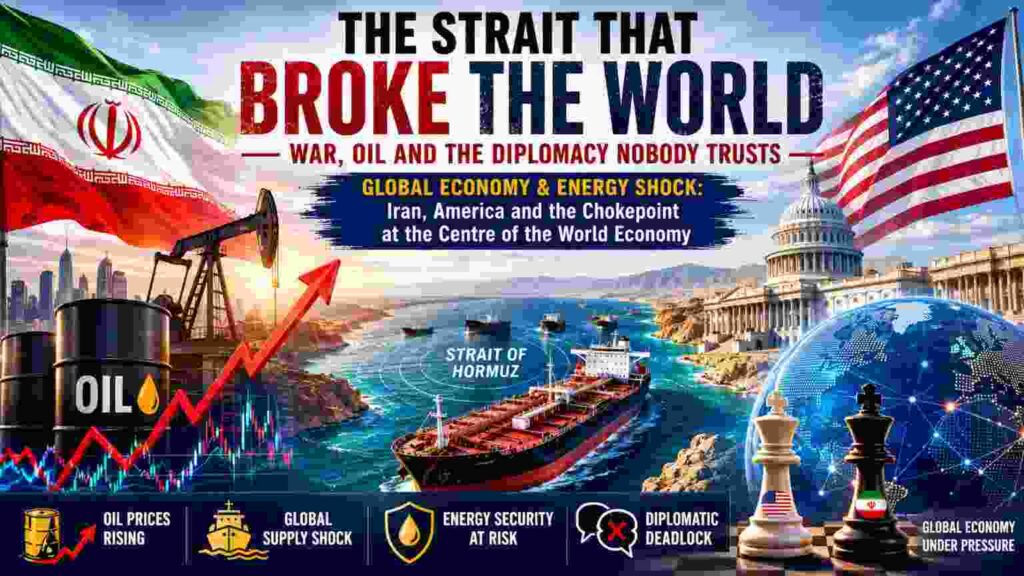
Illustrated Image
On Day 102 of the Iran conflict, the global economy bleeds slowly while negotiators circle without landing
By MGN Global Economics Correspondent |
Neither Peace Nor War — Just Damage
One hundred and two days since the United States and Israel launched coordinated strikes on Iran, the world has settled into something more dangerous than war: a prolonged state of armed ambiguity, where missiles fly intermittently, diplomats meet inconsequentially, and oil markets absorb body blows with no end in sight.
The conflict, which began on February 28, 2026, embroiled the entire Middle East region — a confrontation years in the making, built on Iran’s nuclear program, its ballistic missiles, and the collapse of diplomatic efforts to revive the 2015 nuclear deal. The opening salvos were dramatic. What followed has been grimly grinding.
The Chokepoint That Changed Everything
No single geographic feature has done more economic damage faster. The Strait of Hormuz carries roughly a quarter of global seaborne oil trade, along with significant volumes of liquefied natural gas and fertilizers. When Iran effectively shuttered it, the consequences were immediate and historic.
By the end of March, Brent crude had surged roughly 65 percent — its highest monthly rise ever. Global oil supply crashed by 10.1 million barrels per day, the largest quarterly decline since the COVID-19 pandemic.
The U.S. Energy Information Administration now projects that OECD oil inventories will fall to just under 2.3 billion barrels by December 2026 — the lowest level since 2003, and well below the previous five-year average of 2.8 billion barrels. Production shut-ins in May averaged 11.3 million barrels per day. The financial hemorrhage for Iran itself: the Pentagon’s standing estimate puts lost Iranian oil revenue at approximately $4.8 billion under the blockade, while Saudi Aramco CEO Amin Nasser has assessed that market normalization will not occur before 2027.
The Table Nobody Trusts
Negotiations exist — but barely. Iran suspended nuclear talks indefinitely following Israeli attacks on Beirut, causing a sharp decline in market optimism for a near-term peace deal. On June 2, Iran’s supreme leader declared that U.S. military bases in the Middle East were no longer safe, signaling a hardening stance even as indirect talks continued.
Trump, characteristically, called the process “boring.” Tehran, for its part, has returned to the table even while under fire, with Ahmad Khomeini warning Iran remains ready “to respond through resistance, through war, or through missiles.”
Meanwhile, Russia’s Vladimir Putin offered at the St. Petersburg International Economic Forum to once again remove enriched uranium from Iran — as Moscow did under the 2015 deal — calling it a viable path forward.
The Economic Verdict
Saudi Arabia’s Energy Minister Prince Abdulaziz bin Salman stated plainly: “Without energy security you will lose affordability, you will lose sustainability.” Few economists would disagree. ING’s revised base case now sees Brent averaging $104 per barrel through Q2 2026, with a slow recovery to $92 by Q4 — assuming flows through Hormuz gradually resume and infrastructure damage proves manageable.
That assumption is doing heavy lifting. A war still firing, a strait still choking and a deal still missing — this is not a crisis approaching resolution. It is a crisis learning to breathe.
*Data sourced from the U.S. EIA Short-Term Energy Outlook (June 2026), World Bank Commodity Markets Outlook (April 2026), UK House of Commons Library, Carnegie Endowment for International Peace, and GlobalSecurity.org.*