
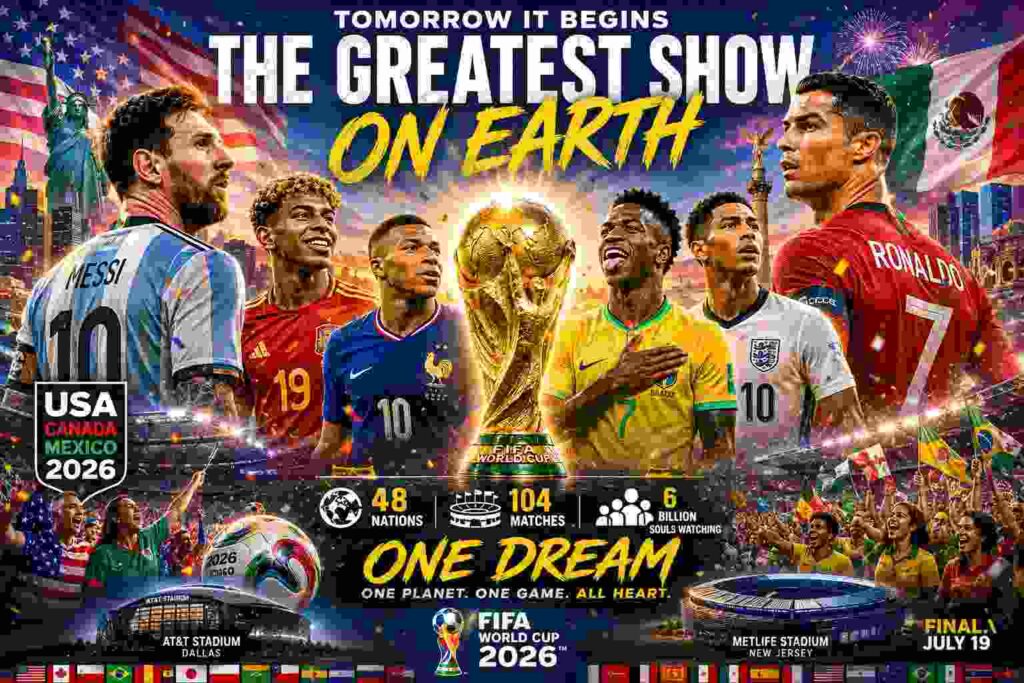
Representative image created for illustrative purposes only
48 nations. 104 matches. 6 billion souls watching. The legends take their last bow, the heirs reach for their crowns — and the planet holds its breath.
The planet Earth has approximately 8 billion souls. FIFA president Gianni Infantino is already promising six billion of them. Not followers. Not subscribers. Human beings — from Lagos to Los Angeles, from Buenos Aires to Bangkok, from a pub in Manchester to a rooftop in Cairo — all pointing at the same screen, holding the same breath, feeling the same thing.
Tomorrow, it begins. And nothing will ever be quite the same again.
The 2026 FIFA World Cup is shaping up to become the largest sporting event in human history, both in terms of audience reach and economic impact. Co-hosted across the United States, Canada, and Mexico, it features 104 matches — 40 more than the last tournament — across 48 nations, the highest ever. Current projections estimate total attendance somewhere between 5 and 7.3 million spectators. Even the lower end of that range would comfortably surpass every previous tournament on record.
Infantino called it “104 Super Bowls in one month.” He wasn’t boasting. He was warning you.
The Last Waltz of the Gods
The first time Lionel Messi walked into a World Cup dressing room, George W. Bush was president, the iPhone did not exist and Cristiano Ronaldo still wore his hair in frosted tips. Twenty years later, the two men who swallowed a generation of football whole are packing for North America with a question neither has ever had to answer before: what do you do when there is no next time?
Messi, aged 38, returns for a joint-record sixth World Cup appearance, defending the title he lifted with such aching beauty in Qatar 2022. Scaloni has built Argentina around a Messi who touches the ball less and decides more — a team engineered to protect its emperor for 60 minutes and trust him for the final 30. Every touch, every shimmy, every no-look pass through traffic — treat it as a Rembrandt being painted in real time. There will not be another.
Ronaldo arrives heading into what is arguably Portugal’s most promising World Cup cycle in recent memory, even if his own body is no longer operating at peak capacity at 41. Five Champions Leagues, a Euro, a Nations League, more international goals than any man who has ever kicked a ball — and yet the World Cup trophy remains the sole void in his footballing legacy. He confirmed it himself: “Definitely, yes — I’m going to be 41 years old and I think it will be the moment.” One last castle to storm. One last mountain to climb, knowing the summit may be too high and the legs may be too heavy. That is not tragedy. That is sport at its most human.
The tournament structure keeps a Messi–Ronaldo knockout clash mathematically alive — a possibility denied to fans for 20 years. To receive it now, in their final chapter, would feel like an extraordinary gift from the football gods.
The New Flame — And the Passing of the Torch
Then there is Lamine Yamal. Eighteen years old. Already terrifying.
The teenager is the most hyped young player to enter a World Cup since a 17-year-old Pelé arrived in Sweden in 1958. The comparison is extreme — but Yamal’s numbers justify the conversation. His sensational wing play powered Spain to the Euro 2024 title, and even rival Vinicius Jr. has declared that Yamal “can win the World Cup alone,” pointing to Spain as the team to beat: “They won the last UEFA Euro, and they’re a squad that has been playing together for a very long time.”
Kylian Mbappé, 26, is just five goals shy of Miroslav Klose’s all-time World Cup scoring record of 16. The fastest man at the tournament, hunting history itself. Vinicius Jr. arrives as one of the biggest stars in world football, voted the Best FIFA Men’s Player for 2024, with Carlo Ancelotti — under whom he flourished at Real Madrid — now trusted to resurrect Brazil’s title-winning pedigree. Neymar, 34, is a surprise inclusion in the squad, adding yet another dimension to the Seleção’s attack.
England’s Jude Bellingham is the most complete player at the tournament — pressing, passing, carrying, scoring — and if England go deep, he will be the reason.
The Favorites — and the Question Marks
Spain and France are the teams the world’s football writers overwhelmingly favour to lift the trophy on July 19. Spain have not lost a single match since March 2024. France carry that lethal combination of talent, depth, and cold-blooded arrogance that makes them perennially dangerous. Manager Didier Deschamps heads into his final major tournament in charge, and his squad has everything needed to send him off with a win.
Brazil sit as the biggest non-European favorites — a side rebuilt by Ancelotti, powered by Vinicius, and quietly carrying the weight of a nation that hasn’t won this thing since 2002. Portugal arrive as reigning UEFA Nations League champions, having defeated Yamal’s Spain in the final. Don’t sleep on them.
History in the Making
The 2022 World Cup final between Argentina and France drew 1.5 billion viewers alone — more than the Olympics, more than the Super Bowl, more than any single event in the history of television. Those numbers are expected to be surpassed.
The 94,000-seat AT&T Stadium in Dallas and MetLife Stadium in New Jersey — where the final will be staged on July 19 — are among the largest covered venues in the world. Estadio Azteca in Mexico City, already the stuff of World Cup folklore, returns for a record third hosting appearance.
Six billion viewers. Five million fans in the stands. Two living legends bowing out. One teenager about to announce himself to all of them.
The curtain rises tomorrow. Don’t you dare look away.