
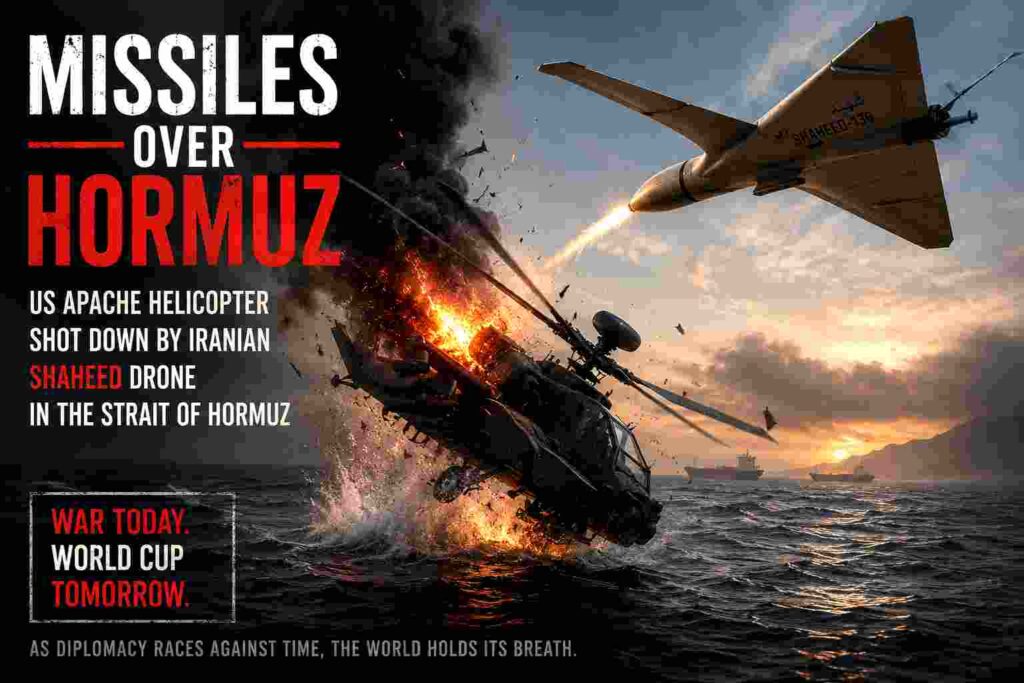
On the day before the 2026 FIFA World Cup opens its first game in Mexico City, the United States and Iran are exchanging air strikes over the Strait of Hormuz, the IRGC has promised what it calls a heavy response before sunrise and a peace deal that Washington describes as days away hangs by the most frayed thread yet of a hundred-day-old war.
This is where the world stands on the morning of June 10, 2026.
The Apache Goes Down — and Everything Escalates
On Monday evening, a US Army AH-64 Apache attack helicopter on patrol near the Omani coast went down in the Strait of Hormuz. Two aviators were rescued within two hours by an uncrewed US Navy drone boat — the first combat rescue of its kind. They survived. The diplomatic architecture did not.
U.S. President Donald Trump announced on Truth Social on Tuesday : “I have just been informed by our Great Military that last night the Iranians shot down one of our highly sophisticated Apache Helicopters while patrolling over the Strait of Hormuz. There were two pilots involved, both are safe and uninjured. Nevertheless, the United States must, of necessity, respond to this attack.”
In a separate Wall Street Journal interview hours later, he called the same incident “not a big deal.” Both statements are, essentially, the Trump doctrine in miniature.
By Tuesday at 5 p.m. Washington time, US Central Command announced it had begun what it called self-defense strikes against Iran at the president’s direction, describing the operation as a proportional response to what it termed unjustified Iranian aggression.
Explosions were reported near Sirik, Jask, Qeshm Island and Bandar Abbas — Iran’s naval infrastructure and coastal missile batteries along the northern rim of the strait absorbing the weight of American retaliation. But these reports are yet to be unverified.
Iran Fires Back. Araghchi Warns. The IRGC Promises More
Iranian Foreign Minister Abbas Araghchi had, earlier in the day, written with calibrated menace on social media : “Foreign forces in proximity to our territory are at constant risk on account of their own human errors, plain accidents, or potentially being caught in crossfire. To reduce risk, the best solution is for foreign forces to exit, as soon as possible, an environment which will never be hospitable to a hostile presence.”
After US strikes landed on Iranian territory Tuesday evening, Araghchi dropped even the diplomatic framing. “Despite its defeats on the battlefield, the US opted to test our determination,” he declared. “Our powerful armed forces will leave no attack or threat unanswered. Leave our region if you want to be safe.”
The IRGC Aerospace Force announced it would deliver what it described as a heavy response, and IRGC-linked channels confirmed missiles and drones were already moving toward US targets in the region before midnight local time.
The cycle is now fully in motion. The ceasefire, however strained, has not been formally declared dead by either side. Tehran and Washington are still, technically, talking.
A Deal Days Away — Again
That is the maddening paradox at the centre of this war. Trump, departing an NBA Finals game in New York on Monday night, told reporters the two sides were “very close to having a very, very good, strong, powerful deal” that he believed could be signed in two or three days.
A proposed memorandum of understanding has reportedly been assembled by Pakistani and Qatari mediators, including provisions for releasing twelve billion dollars in frozen Iranian assets, a negotiated cap on uranium enrichment and a phased reopening of the Strait of Hormuz to commercial shipping.
Araghchi himself has stated that every time a diplomatic solution reaches the table, Washington opts for a military move instead.
The June 7 collapse of a localized Lebanon ceasefire brought the region perilously close to a broader war. Israeli strikes hit southern Beirut. Iran answered with waves of ballistic missiles targeting military facilities and strategic assets inside Israel. Behind the scenes, urgent diplomacy followed. President Donald Trump reportedly moved to prevent a planned Israeli strike on Tehran amid fears of an uncontrollable escalation. Regional officials and analysts indicated that Iran was prepared to strike deeper into Israel and with even greater force should the confrontation widen. The crisis receded, but it did not end. Barely forty-eight hours later, the loss of an Apache helicopter underscored a sobering reality : the Middle East remains one incident away from another dangerous spiral.
Yet diplomacy has not lost its momentum and intensity. Pakistan and Qatar continue to work relentlessly to prevent the crisis from expanding into a wider regional war. Diplomats familiar with the process describe mediators operating virtually around the clock, in close coordination with leaders of key member nations of the influential Muslim world bloc—including Saudi Arabia, Turkey and Egypt—while maintaining active channels with both the Trump administration in Washington DC and the Iranian leadership.
Saudi Arabia’s quiet but consequential back-channel engagement with all sides continues, reflecting a rare convergence of opinion across the Muslim world, the United States, Europe, Russia and China : that the costs of another major regional war between two major military powers would far outweigh any conceivable gains, and that a negotiated settlement remains the only sustainable path forward.
The challenge is that diplomacy is now racing against events. Every new military incident narrows the room for compromise: a tanker struck at sea, an Apache helicopter downed, a civilian airport hit, and American military assets across the UAE, Bahrain and Kuwait repeatedly bombed.
Individually, such incidents may be manageable. Collectively, they create a cumulative pressure that steadily compresses the political space within which any negotiated settlement can survive. The danger is no longer a single dramatic escalation, but the accumulation of shocks that gradually overwhelms diplomacy itself. No single episode may be enough to derail negotiations. The accumulation of them, however, threatens to suffocate the very diplomatic opening that regional mediators are working tirelessly to preserve.
The Football World Cup Opens Tomorrow. Iran’s Team Lands Today
The surreal counterpoint to all of this is that the 2026 FIFA World Cup kicks off at the newly renamed Banorte Stadium in Mexico City tomorrow with Mexico facing South Africa. Co-host United States plays its first game on June 12. And Iran’s national football squad was due to arrive at its Tucson, Arizona training base by today, June 10 — the same country whose military is currently striking Iranian naval targets.
Iran’s first group match is June 15 against New Zealand at SoFi Stadium in Los Angeles. In a conflict where Iranian football federation officials were denied US visas, where Iran’s sports minister initially declared participation impossible and where Trump suggested it might not be safe for Iranian players to come to America, the Iranian team is nonetheless heading to the tournament.
FIFA president Gianni Infantino, who awarded Trump the inaugural FIFA Peace Prize at December’s World Cup draw in the president’s presence, has insisted the schedule will not change and Iran will compete.
Football, the saying goes, unites the world. This summer, it arrives at a moment when one of the world’s most powerful militaries and one of its most resilient and strategically consequential powers—whose endurance and capabilities were tested during the intense conflict preceding the ceasefire—are navigating a confrontation that has stretched the limits of deterrence, diplomacy and regional stability. Yet even as negotiators in Islamabad and Doha work to transform fragile understandings into lasting agreements, a broader reality is emerging : from the Muslim world to Washington, Europe, Moscow and Beijing, support for de-escalation has become stronger than support for escalation.
The World Cup will not resolve the region’s disputes. But it will offer a rare reminder that nations capable of competing fiercely can also coexist peacefully. In a season defined by uncertainty, and in a world searching for stability, that may prove to be the most important victory of all.