
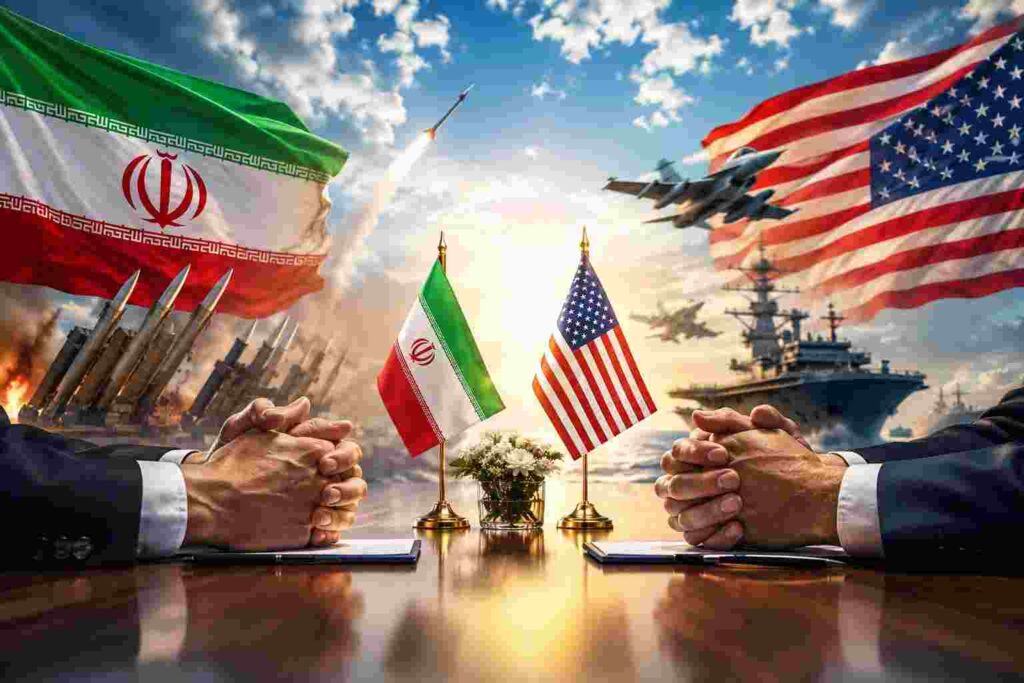
Representative illustration depicting rising military tensions and continuing indirect diplomatic engagement between the United States and Iran. Despite fresh exchanges and growing regional risks, negotiators continue efforts to prevent a wider conflict and secure a lasting settlement. MGN Illustration 110626C778
The waters off the southern coast of Iran have become the most watched 21 miles on the planet. On the night of June 10, 2026, American forces launched a fresh round of strikes against targets inside Iran. Tehran responded swiftly with precision. Then Washington struck again and Iran struck back immediately.
And yet, for all the fire and fury of the public statements, something significant is also true : neither side has yet chosen to blow the door off its hinges.
What is unfolding in the Persian Gulf is not, at least not yet, a full-blown war in the traditional sense.
It is something more unnerving in its own way — a dangerous, deliberate exchange of force between two heavily armed adversaries, each calibrating its blows carefully enough to signal resolve without triggering a catastrophic spiral.
Both Washington and Tehran understand what unrestrained escalation would cost. That shared understanding is, for now, the only ceiling in the room.
The roots of this crisis run deep. What began on February 28, 2026, as a joint American-Israeli military operation against Iranian nuclear and military infrastructure has since evolved into an extended confrontation that has drawn in the entire Gulf region.
The original calculation in Washington’s Trump administration, heavily influenced by the Netanyahu government in Tel Aviv, was built on the belief that Iran had been strategically weakened.
Years of sanctions, domestic pressures and the losses suffered by Tehran’s regional allies led a section within the Trump administration to amplify the Israeli narrative and persuade President Trump that Iran’s capacity to absorb and respond to a major military challenge had diminished significantly.
Encouraged by Prime Minister Benjamin Netanyahu’s exaggerated assessment that the balance of power had shifted decisively, they believed the risks of military escalation were manageable and that Tehran could be coerced into accepting a new regional reality.
Subsequent events would test that assumption—and prove far costlier than many in America had anticipated.
Iran’s response was to reach for its most potent geographic lever — the Strait of Hormuz. Through that narrow corridor flows roughly a quarter of the world’s seaborne oil supply and a fifth of global liquefied natural gas.
Iran’s Revolutionary Guard moved to make that corridor hurt : attacking merchant vessels, laying sea mines and issuing formal warnings that any ship linked to the United States, Israel or their allies would be considered a valid target. Shipping firms pulled back.
Energy markets climbed. The economic pain radiated outward fast enough to push U.S. inflation past four percent.
America launched an aerial campaign in mid-March to reopen the passage, followed by a naval blockade of Iranian ports through April into May. The pressure was real, but so was Iranian resistance.
Then this week, a U.S. Apache military helicopter was downed near the strait — the kind of incident that compresses decision-making time dangerously. American forces struck Iranian ports and islands in response.
Iran swiftly retaliated with attacks on major U.S. military bases in Bahrain, Kuwait and Jordan. President Trump declared Iran would pay a steep price. The language escalated even as the strikes themselves remained, by the standards of great-power conflict, bounded.
That boundary matters. Experienced analysts watching this exchange note that both sides continue to leave channels open. Back-channel diplomatic contacts have not been severed.
Iran has not moved to permanently close the strait or attack U.S. carrier groups directly. Washington has not targeted Iranian civilian infrastructure or moved to topple the government in Tehran.
The UN nuclear watchdog’s demand for urgent access to Iranian nuclear sites — issued this week — is itself a signal that the international community still sees a diplomatic off-ramp worth pursuing.
The risk is not that either side wants total war. The risk is the gap between intention and outcome — the downed helicopter that was not supposed to be downed, the retaliatory strike that lands harder than planned, the miscommunication in the fog of a volatile night that forecloses options neither side meant to foreclose. History’s worst conflicts have rarely begun with a decision to go all the way. They have begun with a step that seemed manageable until it wasn’t.
For now, two powerful adversaries are exchanging carefully measured force over one of the world’s most critical waterways, watching each other closely, keeping back-channel lines technically alive and hoping the other side reads the signals correctly. It is a high-stakes exercise in coercive bargaining — and the margin for error grows thinner with every exchange.